 The Festa di Roma 2019 comes alive on 31 December 2018 and 1 January 2019
, offering residents and visitors alike a 24-hour festival with over 100 performances and 1,000 artists from 46 countries and 5 continents over a vast area of 70,000m
2 stretching from Piazza dell'Emporio to the Giardino degli Aranci, the Circus Maximus, Via Petroselli, the Lungotevere Aventino, the Lungotevere dei Pierleoni and the Island in the Tiber.
The city council and its cultural institutions have been working on this special edition for a whole year to bring you an absolutely unique experience. For a whole day the pedestrianised heart of the Eternal City will be turning into a dreamlike backdrop for performances, shows, installations, musical events, screenings and whole lot more, all inspired by a common theme, The Moon, to celebrate the 50th anniversary of man's first landing on our satellite. Our natural satellite and the landing, the conquest of space and the dream of travelling in the cosmos fifty years after man first set foot on its pockmarked landscape are still a source of inspiration and a symbol of fantasy, of a different dimension and, by extension, of the absence of gravity, of all that is ethereal and romantic.
www.lafestadiroma.it
The Azienda Speciale Palaexpo is contributing five artistic events to this edition of the Festa di Roma.
On the night of 31 December the Circus Maximus will be hosting the Piccola Orchestra di Tor Pignattara, a multi-ethnic ensemble of extraordinarily talented musicians who have captured the attention of the public and the media alike by cooperating with internationally celebrated artists. From midnight and throughout the festival on 1 January, a huge inflatable moon reproducing NASA images will loom over the city from the Giardino degli Aranci. Called the Museum of the Moon, this is in fact a travelling installation designed by British artist Luke Jerram. On Largo Amerigo Petrucci Photon, a luminous sculpture by Hungary's Koros Design, at once impalpable and monumental, will light up at midnight on 31 December like some star drawn by a child that has landed by magic on the banks of the Tiber. On 1 January at the Clivo di Rocca Savella, two magical sci-fi masterpieces of the silent movie era from the early 20th century will be at the heart of the Silent Moon cine-concert, set to original music composed specially for the event and performed live by the Piccola Orchestra di Tor Pignattara. At the Portico del Basamento Aventino ONNPeople by FLxER Team and Ipologica is an interactive audio-video installation offering a unique visual and sound experience to the public on 1 January.
Rome, Circus Maximus | 31 December
Piccola Orchestra di Tor Pignattara - Live
conducted by Pino Pecorelli
concert
produced by the Azienda Speciale Palaexpo
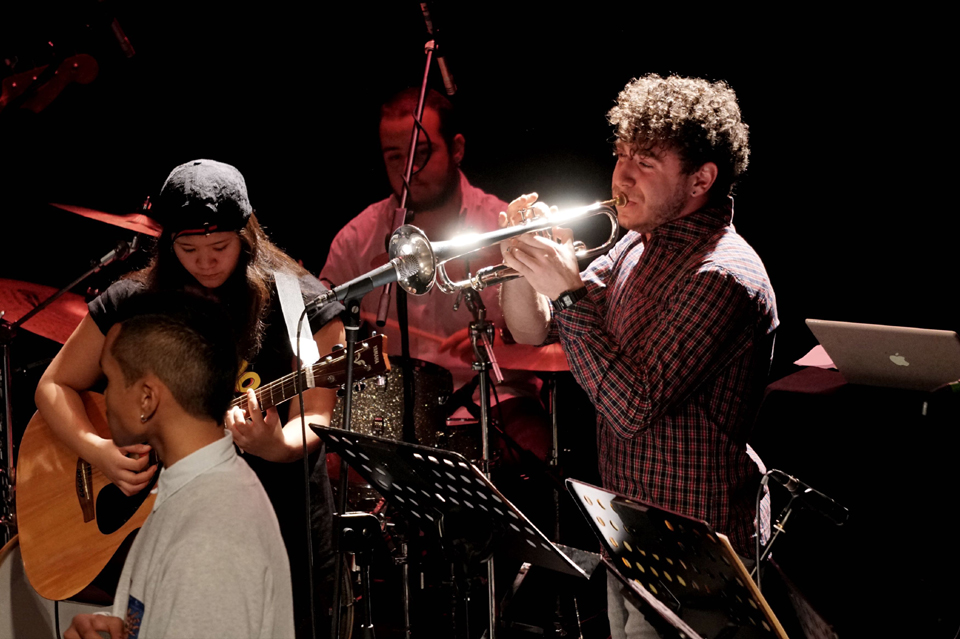
The Piccola Orchestra di Tor Pignattara, a multi-ethnic ensemble made up of young musicians between the ages of 17 and 20, will be performing on the stage at the Circus Maximus for the first time on the last night of 2018 to salute the old year in music. The concert's dense programme with its energetic and exciting set will include original pieces composed and performed by the Piccola Orchestra di Tor Pignattara that will also appear on their new album due to be released in 2019, together with a handful of cover versions that have become part and parcel of the ensemble's repertoire. Their powerful, contemporary urban sound is a child of our time, stretching from the rhythm of hip hop to the accents of drum'n'bass, the flow of reggae, the energy of funk and the light touch of pop.
The Piccola Orchestra di Tor Pignattara is the product of a unique experiment involving bringing together girls and boys with roots in different countries of the world for the sole purpose of making music and of developing their own sound – a permanent workshop capable of giving a sound to a constantly changing reality, a product of cultural encounter and cross-breeding that in the space of only a few years has drawn media attention nationwide, working with international and underground artists alike (including Mika, the Orchestra di Piazza Vittorio, Francesco Di Bella, Pino Marino, Danno del Colle der Fomento and Mama Marjas) and has caught the interest of institutions ranging from the Ministry of Cultural Assets and Activities to the Ministry for the University and Research, and of such social structures as Save the Children, Intersos and Italian universities for both its musical value and its ability to talk to society.
Rome, Giardino degli Aranci | 31 December 2018 – 1 January 2019
Museum of the Moon
by Luke Jerram (UK)
installation
curated by the Azienda Speciale Palaexpo in conjunction with Flyer Communication
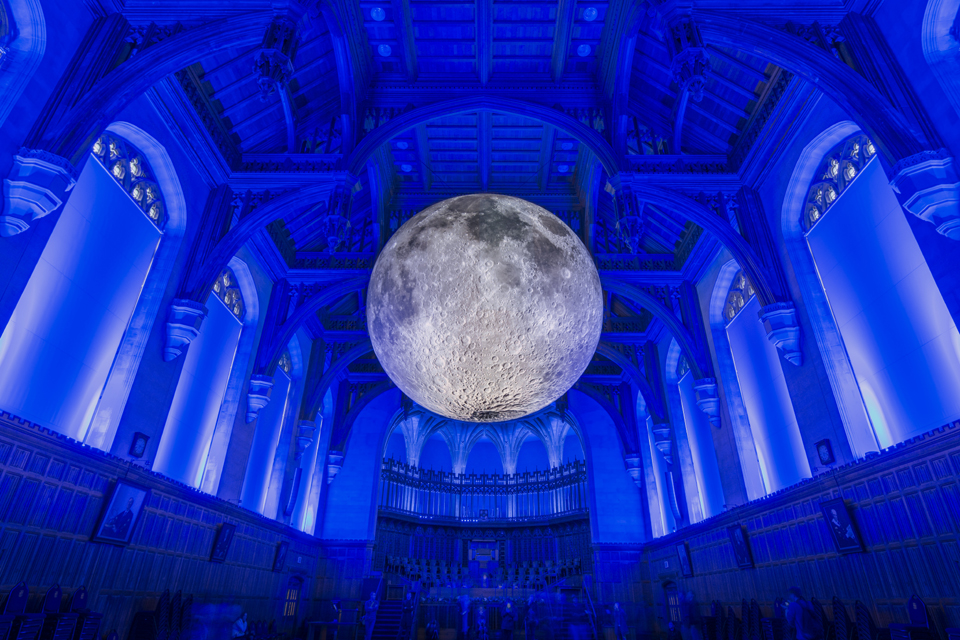
After orbiting in the skies of the most important festivals all around the world, the travelling project designed by British artist Luke Jerram is coming to illuminate the Festa di Roma. Consisting of an astonishing replica moon suspended in the void and lit from the inside, it uses NASA's high-resolution images to faithfully reproduce the moon's surface, from its craters and its mountain chains down to the smallest details, in its seven-metre diameter. Using a scale of 1:500,000, each centimetre on this huge spherical sculpture corresponds to five kilometres on the moon's surface.
Combining science with a poetic mood, the installation is accompanied by an enchanting soundtrack specially composed by Dan Jones, winner of the Ivor Novello and BAFTA awards.
Since the dawn of man's adventure on earth, the moon has always represented a mirror in which he has reflected and projected his beliefs, his ideas and his convictions. Venerated down the centuries as a goddess, the moon has been our ancestors' clock and calendar, a nightlight for sailors, and at the same time a muse inspiring artists, poets, writers and musicians, influencing the history, culture and religion of every civilisation on the planet. To mark the 50th anniversary of the moment man first set foot on the moon, the Festa di Roma is offering audiences in the city the magical illusion of being almost able to touch our mysterious satellite with their finger while also revealing the side we cannot see, the hidden face of the moon that is generally concealed from our gaze. This magical yet surprisingly realistic apparition, like all fairy-tale spells, will last only the time of the Festa before shooting off again into its unending orbit, because as a six-year-old girl asked the artist: "You will be putting it back afterwards, won't you?"
Museum of the Moon was co-commissioned by a series of cultural institutions brought together by Luke Jerram and by the Norfolk and Norwich Festival. They include At-Bristol, Lakes Alive, Provincial Domain Dommelhof, Brighton Festival, Greenwich+Docklands International Festival, Les Tombées de la Nuit, Rennes and Kimmel Center for the Performing Arts. The work, created in conjunction with the UK Space Agency, Bristol University and the Association for Science and Discovery Centres, is part of the European INSITU and Without Walls networks.
Roma, largo Amerigo Petrucci | 31 December 2018 – 1 January 2019
Photon
by Koros Design (Ungheria)
installation
curated by the Azienda Speciale Palaexpo in conjunction with Flyer Communication and with the support of the Accademia d’Ungheria in Roma
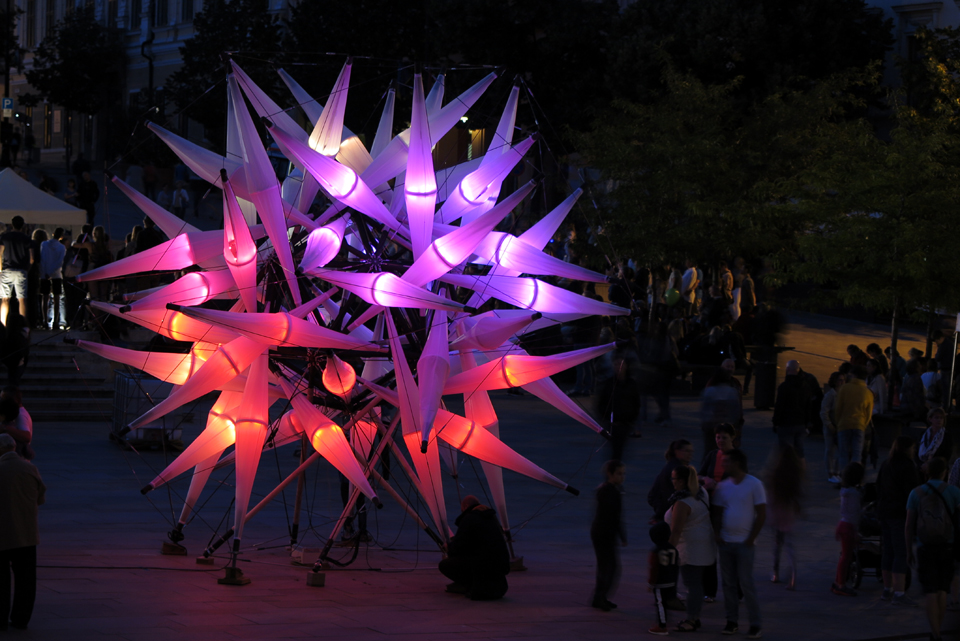
The luminous sculpture, at once ethereal and monumental, conjures up the image of a shooting star drawn by a child that has landed by magic on the banks of the Tiber. It is a work by Koros Design, one of the most innovative creative talents in Hungary today that seeks the inspiration for its artistic creations directly in the world of scientific research.
Light has been studied throughout human history without science having yet proven capable of coming up with a final answer as to what it actually looks like. According to the modern photon theory, light is not simply a bundle of waves, it also contains elementary particles. Photon is one of those particles, blown up for the benefit of us spectators by an ingenious geometrical structure consisting of tubular elements in tension that mutually sustain each other to form a balance of contrasting forces. The luminous structure appears to float beyond our grasp like the sculptural experiments of Italy's Futurists, combining dreamlike vision with technology to convey a pulsating image of nature in motion. Thanks to the light design produced by artist Viktor Vicsek, the magical installation shines with a wavering light akin to that of the shooting star in the Little Prince.
Our special thanks go to Paolo Cignoni and to Nico Pietroni.
Roma, Clivo di Rocca Savella | 1 January
Silent Moon
sci-fi silent movies accompanied by live music performed by the
Piccola Orchestra di Tor Pignattara
conducted by Pino Pecorelli
cineconcerto
curated by the Azienda Speciale Palaexpo
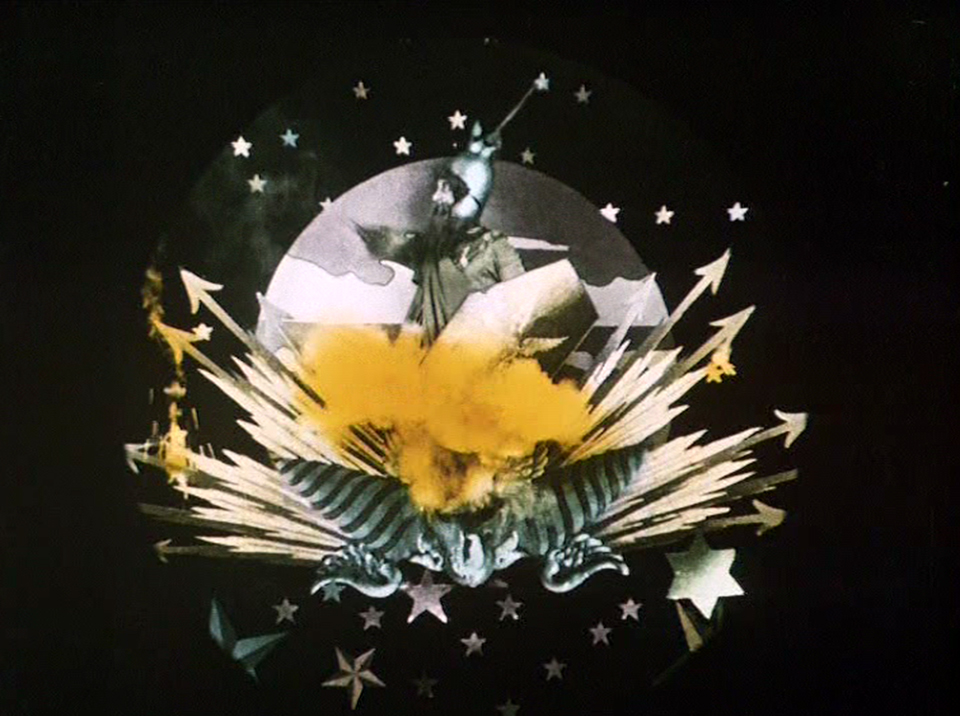
When today's audiences watch a film from the age of the silent movie, often for the very first time, they are invariably dazzled. The evocative power of images without audible words conveys unique sensations, rekindling in our disenchanted eyes the wonder of a journey back through time and space. The cinema, the home of creative fantasy and imagination, has been lifting its gaze to the skies from its earliest days, imagining journeys of discovery to distant planets recreated thanks to phantasmagorical special effects which were very much in their infancy at the time and which allowed audiences of the day to give free rein to man's eternal desire to escape the constraints of the human condition
To breathe new life into the magic of images over 100 years old, we have invited a group of very young but extraordinarily talented musicians, the Piccola Orchestra di Tor Pignattara, to compose an original musical score and to accompany the screenings with live performances at the Festa di Roma for the very first time.
This multi-ethnic, modern and extremely powerful orchestra made up of young musicians aged 17 to 20 was set up in 2012 as the result of a unique experience based on bringing together girls and boys with roots in different countries of the world (second generations, asylum-seekers, children of mixed couples and so on) for the sole purpose of making music and of developing their own sound, in a permanent melting pot capable of giving a sound to this city and to a constantly changing reality, the product of cultural cross-breeding. This urban, contemporary sound stretching from the rhythm of hip hop to the accents of drum’n'bass, the flow of reggae, the energy of funk and the light touch of pop in the space of only a few years has drawn media attention nationwide and the orchestra has worked with such international stars as Mika, the Orchestra di Piazza Vittorio, Danno dei Colle der fomento, Mama Marjas, Francesco di Bella and Pinomarino, and caught the interest of institutions ranging from the Ministry of Cultural Assets and Activities to the Ministry for the University and Research, and of such social structures as the FAO, UNHCR, Save the Children and Intersos for both its musical value and its ability to talk to society.
For the first time the orchestra will be turning its hand to producing and performing a live score for silent movies, creating a fully-fledged original soundtrack for them. Using sounds from both traditional and more "modern" aoustic instruments, the beatbox and electronics in general, the orchestra will endeavour to propel the audience back to the original enjoyment of the silent movie and its ability to translate images into dreams: a dreamy moment in which the musicians use the freshness of their urban vocabulary to recount their vision of the journey to the moon that we all dream of when we are young, that has fascinated artists of every age and that remains forever alive deep inside each one of us.
Programme:
Le voyage dans la Lune
(Journey to the Moon) directed by Georges Méliès, France, 1902, 14 min., silent
Live musical accompaniment composed and performed by the
Piccola Orchestra di Tor Pignattara
When Le voyage dans la Lune was screened for the first time in long-ago 1902, the audience was in effect witnessing the birth of a new genre: sci-fi. The plot is simple: a group of astronomers board a rudimentary space shuttle shaped like a bullet which is fired directly into the face of the moon, from which our intrepid explorers then return to a hero's welcome. For the entire duration of the film we watch the exploits of sophisticated French comedy in a whirlwind of dynamism that brings fiction to life. Like so many travellers in Wonderland, the old astronomers explore the planet, a receptacle of emotions and a symbol of mankind's limitations, recreated here with an inspired, futuristic set design.
Voyage sur Jupiter
(Journey to Jupiter) directed by Segundo de Chomón, France, 1909, 10 min., silent
Live musical accompaniment composed and performed by the
Piccola Orchestra di Tor Pignattara
Our fantasy journey shifts towards Jupiter in this amusing tale directed by Segundo de Chomón. A medieval king hears an old scientist tell the story of the planets in the universe while observing them through a telescope. He falls desperately in love with the planet Jupiter and dreams of governing it just as Zeus used to do in ancient times. His head filled with these fancies, the king falls asleep and dreams of clambering up a heavenly ladder that leads him straight to the planet of his dreams. When he reaches Jupiter, however, he receives quite other than a royal welcome. He is ill-treated by the soldiery and by the planet's sovereign in person before being kicked out. Finally, a mischievous Saturn decides to complete the joke by sawing the ladder and causing him to plummet all the way down.
Roma, Portico del Basamento Aventino | 1 January
ONNPeople
by FLxER Team and Ipologica (IT)
an interactive audio-video installation
curated by the Azienda Speciale Palaexpo in conjunction with Flyer Communication
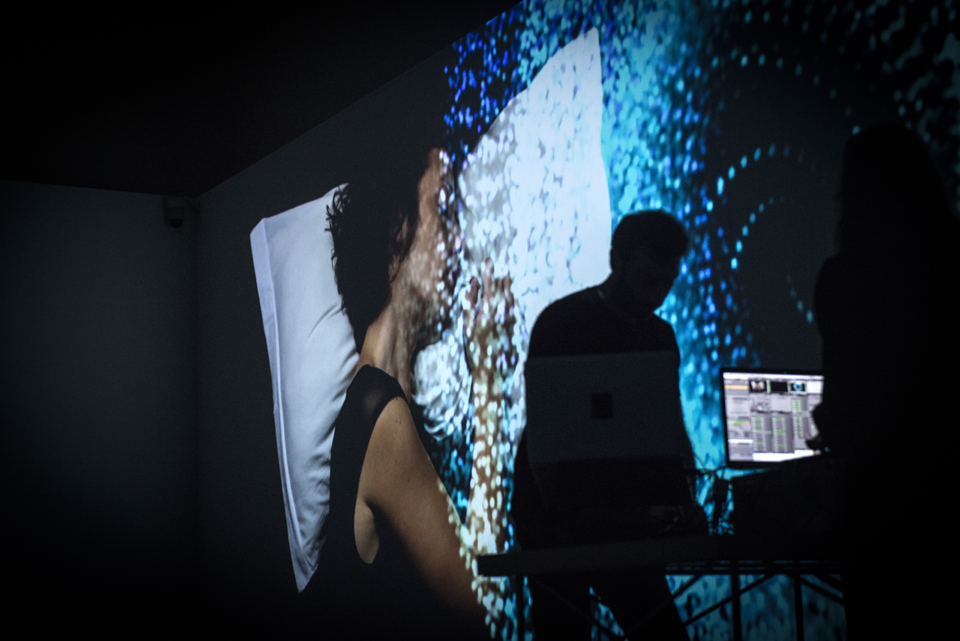
ONNPeople is a constantly evolving interactive audio-video installation. Spectators find themselves entering the projected images and shaping those images' visual result. The subject of the tale told in the projection is a person coping with solitude in its most topical sense: a solitude made of devices, of waiting, of disenchantment and of silence. Working. Eating. Sleeping. Doing, doing, forever doing. In a reiteration that slowly fades into déjà vu and turns into imagination, the imagination of something magic, of something that breaks down and becomes something other, something else.
Through the direct use of our Leap Motion infrared sensor and of a number of Midi Controllers, people become part of the creative process, destructuring the projected image in accordance with to their own visual and auditive sensations. With the movement of their hands, they can manipulate and generate videos and sounds in real time, thus enjoying an opportunity to live a unique visual and sound experience.
Thus the tale hands the baton to the observer who, in experimenting and playing with the software, moves the image and discovers new declinations of the video projected in front of him or her. This installation is based on a concept known as ONNFrame, a live audio-video performance that made its debut at the Palazzo delle Esposizioni's Live Cinema Festival in September 2018.
The FLxER Team was established in 2001 around the development of the FLxER software devised to allow the use a computer to produce a live video performance, much as had already been the case for some time in the production and enjoyment of electronic music. Given that no "consumer" video software on the market made it possible to perform in real time, the inevitable solution was to design and develop an independent application to resolve the problem. The performance project in this specific instance involves Gianluca Del Gobbo (Project Manager), Gabor Kitzinger (Designer, Software Developer), Emanuele Tarducci (Designer, Interaction Developer) and Elisa Antonacci (Visual Artist).
Ipologica is an artists' collective set up in Rome in 2006 and linked to the world of electronic music, that concerns itself with producing music in such different environments as sound design, live performance, dj set and multimedial installation sounds. The faces and minds behind Ipologica are: Fabio Sestilli, Giulio Maresca and Valentina Mignogna.
La Festa di Roma is promoted by Roma Capitale - Assessorato alla Crescita culturale wiith the support of Dipartimento Attività Culturali and the collaboration of the city's cultural institutions.